Search This Blog

Friday, January 28, 2022

THE SHEPHERD FAMILY of HENRICO COUNTY, VIRGINIA, especially pertaining to the life events of ROYAL FLEMING SHEPHERD (1789-1850): Chapter 7

CHAPTER 7:

A Few Loose Ends: The Children of Royal F. Shepherd


After the death of his father, Samuel D. Shepherd (1821-1896) returned to Daviess County, Kentucky and resided with his father’s cousins Thomas M. Shoemaker (1796-1863) & Royal F. Shoemaker on Panther Creek. Samuel also had his aunt Nancy Shepherd (daughter of Reuben and Sally Cocke) who married Richardson Jones, in 1813, as a resource, as they also had resided in Daviess Co, Kentucky, since about 1835. Samuel began work as a teacher, and did so for many years. In the early 1850s, he was elected to the office of County Surveyor and then later worked for the Internal Revenue Service as a gauger. He was described as, “well educated, a good neighbor, kind and courteous, though of a rather retired disposition, and took little interest in society.” On April 27, 1854, Samuel D. Shepherd married Melvina Downs (1833-1921) of Daviess County, Kentucky. She was the daughter of David (1802-1858) and Elizabeth Downs (1814-1850). Samuel and Melvina had no children of their own, however, they adopted their niece, Rhoda E. Shepherd (1865-1910) prior to 1880. Samuel D. Shepherd died on July 23, 1896, in Owensboro, Daviess County, Kentucky, at 75 years of age.

Royal Fleming Shepherd, Jr. (1824-1863), had moved to the town of Lynchburg, Virginia in 1847, at 23 years of age to work as a machinist. He had a strong proclivity to partake in spirits and other vices, which made him a lively companion, though on other occasions insufferable. On August 21, 1848, he married Jane Ann Cochran (1824-1863). On October 13, 1852, Royal and his wife Jane had their first baby, a girl they named Mary Emma Shepherd (1852-1891). Needing more secure living conditions, Royal purchased their first house in Lynchburg on August 15, 1853. The lot was one fourth of an acre, with 45 feet of frontage on Second Street (also known as Main Street) and was 80 yards deep. The house was partly unfinished, containing five rooms.

Unfortunately, becoming a family man only worsened Royal’s debauchery, anger and abuse. Only a few months after purchasing their house, Jane became so fearful for the safety of herself and her baby, that she moved out and sheltered at the home of her aged father George Cockran. As with many abusive relationships, there was a brief reconciliation with the empty promise of change. The relationship failed; However, not before Jane became pregnant with their second baby in 1854, a girl named Mildred Ann Shepherd (1854-1885). After Jane became pregnant, Royal fully abandoned his wife and children, and went head first into self-destruction. He ceased working and offered no financial support to his family.

After the death of Jane’s father, circa 1856, she and her two children were given shelter at the home of Mr. Segar S. Coffee. In 1857, Jane filed for divorce from her estranged husband, which was granted by the court. Numerous witnesses were called to testify to the bad character of Mr. Shepherd, stating that he was a “trifling man” and had “idle habits, [being] addicted to drunkenness, for several years he left Lynchburg for Richmond and was a good deal of the time confined in jail on account of his drunkenness.”

On March 10, 1862, Royal F. Shepherd, Jr., enlisted in Company A of the 4th Virginia Confederate Infantry at Wythe County, Virginia. He was a part of Stonewall Jacksons Brigade that fought at Chancellorsville, where he was wounded during the battle on May 3, 1863. Royal was taken to Camp Winder Army Hospital in Richmond, where he died on May 15, 1863, twelve days after his injury. Royal F. Shepherd, Jr., was buried in the soldier’s section of Hollywood Cemetery in Richmond, Virginia.

Tragically, Jane Ann (Cochran) Shepherd (1824-1863) died the following month on June 2, 1863, orphaning her two young daughters. Jane was buried next to her father at Lynchburg Cemetery. Jane’s daughter Mary Emma Shepherd (1852-1891) married Charles Woolwine on September 23, 1880. Jane’s daughter Mildred Ann Shepherd (1854-1885) married William Armistead Brown (1849-1924) on May 7, 1874. Both daughters were blessed with faithful caring husbands and many children during their years of marriage.

The author had found little information on what became of William Shepherd (1826-?) after the death of his father. William’s uncle Samuel Smith Cottrell (1782-1855) became his segregate father and helped him get established. On December 2, 1850, William was residing at his uncle Cottrell’s home in Richmond and was training in the mastery of saddle making. Beyond this date, nothing more is known. Perchance some future researcher will have the good fortune to discover the rest of his story and perhaps a continuation of his lineage.

After the death of her beloved father, Jane Ann Shepherd (1828-1895) was watched over by her uncle Samuel Smith Cottrell (1782-1855). She and her brother William (1826-?) moved into her uncle’s house in Richmond, where they both learned the art of saddle making. On November 18, 1852, Jane married Robert Harvey Shepherd (1823-1902) in Lynchburg, Campbell County, Virginia. Despite the similar surname, there was no previous familial connection between the families of Robert or Jane. In 1860, Robert H. Shepherd operated a foundry near Lynchburg under the firm name of Shepherd & Co., consisting of Robert H. Shepherd and his partners, J.W. Robinson, M.B. Tate and J.J. Mahone. Robert and Jane would spend their lives in Lynchburg. They were blessed with nine children during their 43 years of marriage.

THE SHEPHERD FAMILY of HENRICO COUNTY, VIRGINIA, especially pertaining to the life events of ROYAL FLEMING SHEPHERD (1789-1850): Chapter 6

CHAPTER 6:

The Move to Richmond: 1840-1850


Royal F. Shepherd had withstood the initial wave of the Panic of 1837, with little variance in his land, slave and livestock holdings. In 1837, Royal had six slaves and five horses, and, in 1839, he had five slaves and four horses. His 161 ½ acre plantation in the Upper District of Henrico County had been faithful over the years, producing all the crops and income needed to sustain him and his family. Unfortunately, for Royal F. Shepherd another catastrophic event beyond his control would descend upon Henrico County during the midst of the national financial crisis. This second event would not spare Royal from near ruin.

During the summer of 1838, Virginia endured a suffocating heatwave and sustained drought causing significant crop failure. It clearly could not have come at a worse time. Prior to the year 1837, Virginia produced on average 45,000 hogsheads of tobacco for market. However, in 1838, this number declined to 26,000 hogsheads produced. Even worse, was that 3/5 of the Virginia tobacco sent to market in 1838 was deemed as inferior quality at inspection. In many areas, the drought also suffered the corn and wheat crops beyond recovery. That year, the drought had been so significant that an overseer of a large farm along the James River, just below Richmond, stated, “[This year] we will make little more than bread for the plantation.”

The Panic of 1837, combined with the drought of 1838, financially distressed Royal F. Shepherd beyond recovery. On August 12, 1840, at 51 years of age, Royal resigned his status and vocation as a Virginia planter by selling his 161 ½ acre
plantation in Henrico County to Dr. Richard S. Cauthorn, son-in-law of Samuel Brown (1771-1847), for the pittance of $6.21 per acre. Royal had assembled his farmland over his lifetime from an initial inheritance of 49 acres. The additional 112 ½ acres were purchased through multiple deeds from 1812 through 1834, with a price per acre ranging from as low as $8.03 in 1812 to as high as $14 in 1834. Royal abandoning his beloved plantation and home for such a paltry price only emphasized the desperation he was enduring.

Mr. Shepherd moved his family ten miles to a new dwelling in the city of Richmond. On August 24, 1840, he purchased from Rebecca Williams a two-story townhouse on a small lot fronting Catherine Street, identified as part of town lot No. 57 in the Bullock Harris addition, for the sum of $750. The lot was only 46 feet 6 inches wide

by 104 feet 3 inches deep. The Census of 1840 recorded that 15 people lived at the modest residence of Royal F. Shepherd, including himself, his children and his four slaves. The other residents were likely the Hopkins children, of whom he became guardian in 1833. Interestingly, six of the members of the house were identified as being employed in manufacture or practicing a trade. No doubt the Shepherd family longed for the serenity and space of their former pastoral life. However, one great solace was that Royal’s only surviving brother Samuel Shepherd resided nearby.

While Royal may have longed for more rural settings, his children would have likely enjoyed the adventure of their new surroundings. In 1840, Richmond had a population of approximately 20,000 residents. Markets, shops, churches, schools and friends were all readily accessible. Everywhere around them bustled with business and social opportunities, creating temptations and challenges that country life seldom offered. This would have been a very exciting time for the Shepherd children. The family would spend the winter of 1840-1841 at their new residence acclimating to the new surrounds of Richmond.

One of the initial connections that the Shepherd family made upon settling in Richmond was joining the Third Baptist Church, on Shockoe Hill, located on I Street, about 60 yards from the corner of I Street and 11th Street. The church had been organized and built in 1833, however, by 1845, it had already outgrown its walls. The congregation then moved to a new location on Foushee Street and Grace Street, whereby, the name was changed to Grace Street Baptist Church. The church moved again in 1923, to its present location on Grove Street, and the name was shortened to Grace Baptist Church. Unfortunately, fires in 1896 and 1946 destroyed the church records prior to 1872.


In the Spring of 1841, less than a year after the Shepherd family moved to Richmond, a most devastating and heart-breaking accident occurred. On Saturday evening, June 5, at approximately 8 pm, Royal’s son Mosby Shepherd (1822-1841) drowned on the James River near the 12th Street Haxall’s Flour Mills. The youth’s corpse was recovered from the river and a coroner’s inquest was held over the body on Sunday morning. The verdict returned was “accidental death by drowning.” An article from the June 8th Richmond Whig newspaper offers us a glimpse of qualities and characteristics of this young man:

“In the character of this youth, we have an example worthy of imitation – possessing, as he did, qualities which are calculated to do honor to any one, especially to one of his age. The subject of this notice enjoyed the confidence of his employers in a great degree- polite and refined in his manners – and above all, a believer in the religion of the Savior, having become a member of the Third Baptist Church about twelve months since; and since he joined the church, his conduct has given evidence of his strict adherence to the principles which he had professed. In this unfortunate occurrence, we are reminded of the shortness of life, and of the truth contained in the Scriptures, that “in the midst of life we are in death’ – for little did this youth suppose that he would so soon be summoned to answer for the deeds done in the body.”

Almost without mercy, shortly after the tragic drowning of Royal’s son, his daughter Elizabeth Shepherd (c.1815-c.1842) died. No records have been yet located describing how she perished; however, she was alive in Richmond in 1840 and was deceased before 1849.

One can only weep for a father who loses so many beloved children in the vibrant prime of their lives. furthermore, this was the third child Royal had buried, losing his eldest daughter Mary A. Shepherd (1811-1832) in 1832. Royal F. Shepherd was like Job from the Bible, losing most everything and everyone he loved, all the while, drawing closer in faith through his similarities to the suffering Christ. With such unbelievable unrelenting loss, he was devastated and fell into a hard depression over all that had befallen him over the last few years. Understandably, his health suffered from his heartache, financial worries and stress.

In 1842, Royal purchased a bottle of “Smith’s Bitters of Renovator of Heath,” and found temporary relief from a condition of chest pains, originating, circa 1838, at the beginning of his financial woes. Bitters were a concoction heavy with mixed alcohols and a touch of herbs and spices. They were sold as medicine. Royal was quick to point out that he only purchased half a bottle “at the permission of some friends,” indicating publicly that he did not recreationally partake in spirits or drugs. This would align with the Baptist teachings of the day, as well as, the temperance movements that surged in the 1830s and 1840s.

Royal’s brother Samuel Shepherd was clearly involved in his life during this time. Over the last few years, Samuel had watched his brother decline, not only financially, but physically as well. It became apparent to Samuel that Royal was now at great risk of faltering on his guardian obligations to the Hopkins children upon which they were both legally bound in the amount of $4000. The law had no empathy for circumstance, so Samuel filed a motion in Henrico County court to remove himself as the security from the guardianship bond of Samuel, William, Alexander, Elizabeth and John Hopkins. The court summoned Royal to prove that he could give counter-security in the amount of $4000, which he was unable to provide. The court then revoked and annulled Royal F. Shepherd as guardian of the orphans, issuing them a new guardian in William Hopkins (1820-1905), thereby, releasing Royal and his brother Samuel from any further legal obligation to their nieces and nephews.

William Hopkins (1820-1905) was the eldest living child of Jacob and Mary Hopkins. His older brother Samuel, having passed away prior to 1842. At 22 years old, William, and his new wife Ann Rebecca Carter (1823-1878), became the legal guardian of his younger siblings John D. Hopkins, Alexander G. Hopkins and Elizabeth A. Hopkins. The orphans remained in Richmond, where William was employed as a carriage trimmer. Alexander G. Hopkins (1823-1849) married Mary Emily Williams (1824-1920) in Richmond Virginia on November 3, 1842. Elizabeth A. Hopkins (1829-1874) married Tarleton H. Woodward (1820-?) in Norfolk. Virginia in 1850.

Although they were released from any legal obligations to the Hopkins orphans, Samuel Shepherd and Royal F. Shepherd, as their uncles, remained involved in their lives. Samuel even recognized Elizabeth A. Hopkins in his last will and testament. Furthermore, in 1850, Samuel’s family lived briefly in Norfolk, Virginia, giving credence that Elizabeth Hopkins joined them and there met her future husband.

On September 17, 1844, Royal purchased, from James A. Davis, the undeveloped town lot next to his own house on Catherine Street for the sum of $100. The lot measured 39 feet 6 inches wide by 104 feet deep, being part of lot No. 59 in the Bullock Harris addition of the city. Royal likely used the lot as a garden or workspace with the assistance of his sons, or his two slaves Claiborne and John.
On November 13, 1847, Royal sold his two lots in Richmond on Catherine Street to William Gilman for the respectable sum of $1,200. He then used a small portion from the sale ($250) to purchase a new lot, 30 feet by 150 feet, on the north side of Marshall Street near the intersection of Monroe Street. Interestingly, his son Samuel D. Shepherd, the year before, had also purchased a lot on Marshall Street. Royal would build a house and slave quarter on this lot, being the last home of his life.

In the mid-1840s, Royal’s sons were becoming legal adults, reaching the age of 21 years. They were filled with all the excitement and passion of young men of their age. A celebration occurred on March 10, 1846, when Royal’s eldest son Samuel D. Shepherd married Maria E. Brown in Richmond Virginia. Maria appears to have been an orphan, as she was a ward of Charles Cottrell. The newlyweds resided in Richmond where Samuel was a carpenter, yet, pursuing an occupation as a teacher. The couple had dreams of building their own home. On April 27, 1847, for $90, they purchased lot No. 25, located in the Bullock Harris addition of Richmond. It had 27 feet frontage on Marshall Street, and was 153 feet deep. Their ambitions, however may have exceeded their capabilities, as only four months later, on August 9, 1847, Samuel and Maria sold this lot for $100 to Evan F. Ragland.

Royal’s middle son, Royal F. Shepherd, Jr., was a machinist by trade, having learned his skill while working in Richmond. From all accounts, after the family moved to Richmond, Royal, Jr., had been slowly deviating from the path of a righteous man, tempted by sinister influences of city life. This created a tension between father and son, eventually resulting in a bitter separation. In 1847, at 23 years old, Royal, Jr., departed from Richmond, Virginia, and settled in Lynchburg, Campbell County, Virginia as a machinist. There is some evidence to suggest that his younger brother William Shepherd, being 21 years old, also initially resided with him in Lynchburg for a few months, after which William returned to his father’s house in Richmond. On August 21, 1848, Royal F. Shepherd, Jr., married Jane Ann Cochran in Lynchburg, Virginia. Jane was the daughter of George and Mary Cochran.


In contrast to the tense relationship between Royal Sr. and Jr., Royal’s daughter Jane Ann Shepherd (1828-1895) was the child of which he was the most proud. They had a joyful relationship and she cared for her father in a respectful and appreciative manner. No doubt, Royal F. Shepherd appreciated having a lady in the house, after losing all the other women of his life to death. For that reason, he held her in great reverence.

Royal also greatly loved his youngest son William Shepherd. Clearly, he was a significant help to his father after Samuel D., and Royal, Jr., left home. William would have greatly assisted with the management of the house, as well as, providing extra income for the family.

In February of 1849, Royal received the shocking news that his brother Samuel Shepherd, at 57 years of age, had attempted suicide. The effort to end his life quickly had failed, leaving him fully conscious but severely wounded. His suicide was rooted in financial worries; however, the cause was the public slander of his reputation among the press and political elite.

Samuel Shepherd had been elected as the Public Printer of the Commonwealth of Virginia when the Whig party took over the majority in the Virginia Assembly during

the early 1830s; effectually ousting from office the old Public Printer, Thomas Ritchie, a democrat and former business partner of Samuel Shepherd. By reputation, Samuel Shepherd was impeccable in his work, a true craftsman and master of his art. Samuel spared no expense in procuring the best equipment and products suited for jobs specific to the Public Printer. In 1844, Samuel had invested heavily in a new three-story brick building equipped with a book-bindery on 11th Street opposite the Capital Square in Richmond. What he did not anticipate was that only four years later the democrats would gain control of the Virginia General Assembly, bringing his livelihood into jeopardy.

In February of 1849, the democrats ran William F. Richie as their candidate to succeed Mr. Shepherd for Public Printer. William F., and his brother Thomas Richie, Jr., had taken over their father Thomas Richie’s newspaper, the Richmond Enquirer in 1845, and had used it as a platform to voice their venomous distain for Whigs and their policy. Their recklessness and personal attacks eventually caused a duel in 1846 between
Thomas Richie, Jr, and the Richmond Whig newspaper editor John H. Pleasants, whereby, Mr. Pleasants lost his life. Lessons not learned, the Richie brothers turned their focus on Samuel Shepherd before the election of 1849, in a public effort to oust him from his office for their own gain. Among a host of other falsities, they claimed that Samuel Shepherd had only been appointed to his office out of political favor, having nothing to do with his skill or talent. Just ahead of the election, Samuel Shepherd realized that the Assembly would vote along strict party-lines, ensuring that William F. Richie would assume the office of Public Printer. Samuel’s reputation had been publicly libeled and slandered and he was days away from being stripped of his source of income, leaving him at the mercy of his debtors. Samuel had witnessed his own brother Royal F. Shepherd’s fall from the financial zenith of a Virginia planter to the depths of a desperate city dweller, and that would not be his fate.

The method Samuel used attempting to take his life was never recorded, however, the effort clearly left him in a state of suffering and humiliation. Unable to work, he resigned from the office of Public Printer for the Commonwealth of Virginia on February 10, 1849. A week later, his democrat successor assumed the office. Knowing the end of his life was near, Samuel dictated and signed his last will and testament on February 20, 1849, being witnessed by his friends Daniel Trueheart, Walter D. Blair and C. W. Purcell. The next day on February 21, 1849, Samuel Shepherd died from the lingering effects of his physical wound. Perhaps out of respect for his family, neither the Richmond Whig or the Richmond Enquirer ran more than few word mention of his death.

It was said of Samuel Shepherd that he was a modest man, a man of talent, a man without reproach. By trade he was a printer and he had followed that business all his life, no one surpassed him in skill, promptness and accuracy. There was not a better printer than Samuel Shepherd in the Union. Samuel was mourned by his wife Maria and their six children. He was laid to rest in Shockoe Hill Cemetery near his home in Richmond, Virginia.

In September of 1849, Royal F. Shepherd’s son Samuel D. Shepherd notified his wife Maria E. (Brown) through the Richmond newspapers that he was filing for divorce. A hearing was held in November, whereupon, Samuel submitted a statement and evidence to a jury supporting the reasons for the separation. The court granted the divorce. Obviously pained, Samuel D. Shepherd needed a fresh start with fresh surroundings. Samuel consulted with his father, who suggested the grand adventure of leaving Virginia for opportunities in Kentucky. As it came to pass, Samuel would migrate to Daviess County, Kentucky, in late 1849, and initially reside with his father’s cousins Thomas M. Shoemaker (1796-1863) & Royal F. Shoemaker. Unbeknownst to Samuel or his father, this would be the last time they would see each other in life.

On January 9, 1850, Royal Fleming Shepherd departed this life from the comfort of his home on Marshal Street in the City of Richmond. In his final hours, he was nurtured, cared and wept for by his 23 year-old son William, and his 21 year-old
daughter Jane Ann. He was buried in Shockoe Hill Cemetery near his brother Samuel Shepherd. His grave was marked with a marble slab headstone. Word of their father’s passing was immediately sent to Samuel D. Shepherd in Kentucky, who returned to Richmond to help finalize the estate.

Royal had died testate, his last will and testament being written on September 29, 1849. He assigned his friend and former brother-in-law Samuel Smith Cottrell (1782-1855) as his sole executor to sell all his property and render the proceeds among his children as directed. Jane A. Shepherd was to receive half of all proceeds and the other half was to be divided between his sons William and Samuel D. Of that half, William was to receive three fifths and Samuel two fifths. His son Royal F. Shepherd, Jr., was to receive one dollar and nothing more, further emphasizing how strained their relationship had been, even at the end.

Samuel S. Cottrell fulfilled his duty as executor of the estate. He had the remaining property of Royal F. Shepherd inventoried and appraised. Items included Royal’s house on Marshall Street, a negro man Claiborne age about 48 years, a Negro man John age about 34 years, sideboard, waiter and lot of glasses, looking glass, fender, shovel, tongs, poker, rocking chair, sofa, carpet, rug, mantel ornaments, secretary, small looking glass, lot of books and slate, clock, pair of brass candlesticks and snuffers, washstand and basin, lot of blankets, comforts and counterpanes, feather bed, bedstead, mattress, etc., old silver watch, bureau, side table, lot of stoneware, small pine table, green bucket, safe, set of mahogany dining tables, German silver table spoons, 6 silver teaspoons, lot china, crockery ware, knives, forks, etc., 6 common chairs, writing desk, 3 chambers, clothes chest, coal skuttles, porch bench, water bucket, lot tools, spades, shovel, cooking utensils, flour & lot barrels in store room.

Mr. Cottrell held the estate sale on January 22, 1850, whereby the above items were sold to the public. Royal’s house on Marshall Street sold to Charles T. Davis for $1,025. His slave Claiborne sold for $250 and his slave John sold for $500. By the end of the day, the total collection of the sale was $2,065.63, to be divided accordingly among his children. In addition, Samuel D. Shepherd, William Shepperd and Jane Ann Shepherd all were in attendance and purchased sentimental items from the sale. Not surprisingly, Royal F. Shepherd, Jr., did not attend.

Royal Fleming Shepherd was a patriarch of his family and a pillar of his community. Though he was orphaned at 6 years old by the death of his father, he had an amazing community of family, in the form of aunts, uncles and cousins that ensured he was loved, educated and directed. He also had a strong council of powerful men that shaped him through example and experience. His youth coincided with the youth of America and he had a pride of his Virginia countrymen from the standards set by Washington, Jefferson, Madison, Monroe, et., al. Throughout his life, Royal protected his gentlemanly reputation, and his good name. He faced the real aversities of life, in the form of war, death, and a fall to poverty. He did not fall himself into the cowardice of drink or all encompassing self pity, but trotted ahead remaining valid and useful. He was compassionate to those in need, and firm with those who were capable of so much more. He had watched his world change around him and his dreams dashed and built again. He offered us a powerful, true and timeless example of what it is to be a man, a father, leader and most importantly a Shepherd, and for that his life will perpetually have meaning and significance.

THE SHEPHERD FAMILY of HENRICO COUNTY, VIRGINIA, especially pertaining to the life events of ROYAL FLEMING SHEPHERD (1789-1850): Chapter 5

CHAPTER 5: 1830-1839

The 1830s was an interesting time for the United States as well as for Virginia. Andrew Jackson was President of the United States, his term in office lasting from 1829 to 1837. He would sign the Indian Removal Act in 1830, that would enact the removal of most eastern Indian tribes to reservations on lands west of the Mississippi River. In 1832, Jackson ordered the preservation the hot springs of Arkansas, becoming the first president to reserve land for the protection a natural resource from development. Jackson became the first President of the United States to have an assassination attempt on his life. He also became the only president in United States history to have paid off the national debt during his term in office, doing so in 1835. One of the most noteworthy events of the 1830s, was the Texas Revolution from 1835 to 1836, whereby, Texas declared its independence from Mexico. The late 1830s would be stagnated by a nationwide financial crisis, known as the Panic of 1837.

Locally during this time, Virginia was engaged in a wide variety of infrastructure improvements. New roads and turnpikes were quickly becoming the main arteries connecting smaller towns and distant cities to Richmond, providing faster and safer travel. From the 1830s to 1850s, the James River Canal was being widened, straightened and rerouted to accommodate better water travel for shipping and transportation as part of Virginia’s infrastructure plan. Bosher Dam, spanning the James River to the city of Richmond, was built as part of this project.

Perhaps the most significant development of the 1830s, in Virginia, was the introduction of the railroads. Most rail lines at this time were of short span, linking vital country commerce, such as coal mines, to the city. However, visionaries and the public alike began to appreciate that “this vast country of ours would be bound together by bonds of iron traversing and ramifying the country in every direction, as a vast net work – binding and riveting the people together by free and general intercourse and a mutuality of interest.” The Richmond to Petersburg railroad, spanning 21 miles across Chesterfield County, opened to the public in 1838. However, the Panic of 1837, brought a near halt to Virginia’s infrastructure development, stifling the railroad boom until the mid to late 1840s.

In 1830, Henrico County, not including the city of Richmond, had a population of 12,737 inhabitants, 46 percent (5,935) of those being slaves. Richmond city added an additional population of 16,060, whereby, 39 percent (6,349) were slaves. On the night of August 21, 1831, beginning at 2 am, a renegade slave named Nat Turner led a slave rebellion in Southampton County, Virginia, only 60 miles from the city of Richmond. The band of about 50 slaves used stolen firearms, axes, clubs and swords to murder 55 whites, including thirteen women and twenty-seven children. Nat Turner was captured on October 30th and hung for his crime on November 11th.

The aftermath of the Turner slave rebellion was widespread panic and fear across Virginia, and had the opposite effect of what of what was intended. Since almost half of the population of Henrico County were slaves, a tremendous unrest and anxiety was felt among the white population for their safety. The Virginia General Assembly received numerous petitions proposing options, such as, expunging all free blacks (generally regarded as problematic) from the state or emancipating all the slaves, however, those motions failed to pass. In response, authorities then enacted greater slave restriction laws and heavier fines were enforced on lackadaisical masters to keep control. Royal F. Shepherd, as a master of six slaves in 1831, would have certainly felt the anxiety of this time. He, no doubt, imagined his wife and seven children, as young as two years old, all being murdered in such a brutal and horrible manner.

As part of the infrastructure improvements during the 1830s, Henrico County Judge William Shapard (1771-1843) ordered that Royal F. Shepherd, Jesse Sneed and William Cottrell be appointed commissioners to view the way proposed to change the road from any point near the fork of the Three Notched Road to any point between said fork and Tuckahoe Creek and the old road. The men were to report back to the court the comparative conveniences and inconveniences that would result to the public and individual landowners if the road was constructed. Interestingly, William Shapard was distantly related to Royal F. Shepherd, as William’s father William Shapard, Sr., (c.1740-1807) and Royal’s grandfather Samuel Shapard (1729-1781) were brothers. It is a wonder if either man would have made the familial connection.

William Shapard (1771-1843), the son of William Shapard, Sr. (c.1740-1807) and Mary Booker (1746-1804), came to the city of Richmond circa 1798 from Granville County, North Carolina. William was a skilled carpenter and house joiner in North Carolina; however, he did not continue this vocation whilst in Virginia, instead establishing himself as a merchant in Richmond. He and his partner, Gustavus
Lucke, created the firm of Shapard & Lucke selling imports off the ships docking at Richmond ports, as well as, selling freight space on outgoing vessels. Shapard & Lucke dissolved their partnership in 1803, only to reunite in 1804 and then finally dissolve again in 1810, whereby, the firm name was changed to William Shapard & Co. In 1809, William began investing in real estate, purchasing Richmond town lot No. 555 from Edmund W. Rootes for the significant sum of $2,475. William had a beloved bulldog named ‘Thaddeus,’ that was stolen, in 1812, by a runaway slave. During the War of 1812, William donated $200 worth of gunpowder in support of the U.S. Army in defense of the city of Richmond. William and his younger brother Robert Shapard (1786-1828) both served in Capt. John R. Jones’ 19th Regiment Virginia Militia, commanded by Lieutenant Colonel John Ambler in 1813 and 1814. From 1815 through 1821, he partnered in business with his cousin Lewis Webb, son of John Webb (1747-1826) and Amy Booker (1752-1835), under the name of ‘Shapard & Webb.’ William also formed a partnership with his brother Robert Shapard, that was dissolved in 1825.

William Shapard became extremely successful in his business and acquired tremendous wealth. He resided at his 1,300 acre plantation known as ‘Westham Cottage’ on the north side of the James River on Big Westham Creek, which was worked by his 54 slaves. A portion of his plantation is now part of the campus of the University of Richmond, whereupon a slave cemetery was recently discovered. In addition to his plantation, he also owned several lots in the city of Richmond in DuVal’s addition and on H Street near Monumental Church. William Shapard was elected as a Justice of Henrico County on April 13, 1824, and maintained his judgeship until approximately January of 1833. He became a member of the First Presbyterian Church of Richmond on May 24, 1828, and was dismissed on January 18, 1838 to join the 4th Presbyterian church of Richmond. In 1827, William petitioned the authorities of Henrico County to establish a saw and grist mill on his plantation along the James River. In 1832, a vandal on two separate occasions set fire to William Shapard’s property, burning down a cottage and two barns filled with farm equipment and grains. He offered a $250 reward for the apprehension of those responsible, and on December 3, 1832, the scoundrel was captured.

There is evidence that William may have married prior to 1818, and that his wife “Elizabeth H. Shapard” died on July 7, 1818 in Richmond. William did marry late in life, at 54 years of age, in 1825, to Catherine Bridges, being the widow of James Bridges. Through their union they had one daughter, named Willianna (1826-1897), born on March 4, 1826. Apparently Willianna was quite a beauty for her time, as musician Gustave Bessner in 1842 composed a waltz in her honor. Willianna married Philip Mayo Tabb (1819-1888) of Richmond, Virginia, in 1845. William Shapard died at the age of 72, on February 16, 1843, and was buried in Shockoe Hill Cemetery in Richmond, Virginia, where his towering stone obelisk remains standing to this day.

A tremendously joyous event occurred in the life of Royal F. Shepherd on September 3, 1832, when his eldest daughter, 21 year-old, Mary A. Shepherd (c.1811-c.1833) married 23 year-old Robert Shepherd (1809-aft.1840), in Henrico County. This moment would have been particularly meaningful, as Mary was the first of his children to wed. Robert Shepherd (1809-aft.1840), was son of Reuben Sheppard (1772-1813) and Sarah Cocke (?-1822), making him Royal’s cousin, as well as, Royal brother-in-law, due to Royal’s marriage to his sister Mildred Shepherd (1800-c.1832) in 1820.

The newlyweds resided in the city of Richmond, where Robert had established himself. Robert was still a minor when his last parents died in 1822, and Samuel Cottrell was granted as his guardian. He inherited a small tract of land, being 11 acres on Old House Branch in Henrico County, from the division of his father’s estate. In 1830, Robert was already living in Richmond, and sold this land to Stephen Duvall (1782-1850) for 50 dollars. Tragically, shortly after their marriage, circa 1833, Mary A. Shepherd died, with no known children to their union. Mary may have died in childbirth, or may have been a victim of the cholera epidemic that swept through Richmond in September and October of 1832, claiming at least 450 lives. After the death of his wife, Robert remained a widower in Richmond until at least 1840, with no slaves. After 1840, Robert vanished from the records.

Almost the same time that Royal F. Shepherd was morning the loss of his daughter, his wife, Mildred (1800-c.1832) died in Henrico County. There is no record of how she passed away, however, her youth would suggest childbirth or illness as the cause. There were some curious events around the time of her death that may have been a factor. The Virginia winter of 1831 was particularly prolonged and harsh causing a terrible hardship on the population. In February of 1832, there was a concern of smallpox in Henrico County, and quarters were established in the city of Richmond for their treatment and isolation. Only a few months later, in September of that same year, a deadly cholera outbreak hit Henrico County, ravaging the population for several weeks.

After the death of his wife, circa 1832, Royal F. Shepherd was now the sole provider and parent for his six surviving children: Elizabeth Shepherd (c.1815-c.1842) was 17 years old; Samuel D. Shepherd (c.1821-1896) was 11 years old; Mosby Shepherd (c.1822-1841) was also 11 years old; Royal F. Shepherd, Jr. (1824-1863), was 8 years of age; William Shepherd (1826-?) was 6 years old; and Jane Ann Shepherd (1828-1895) was four years of age. Royal also had seven slaves, over 12 years of age, that were dependent on his care.

Perhaps as a means of quelling his own suffering, Royal gave support and compassion to those more innocent family members who had also been hit by travesty and loss. On March 11, 1833, Royal F. Shepherd became the guardian of the orphans of his sister Mary “Polly” A. Shepherd (c.1793-?) and late brother-in-law Jacob Hopkins (1790-1825). Until they reached the legal age of 21 years old, Royal assumed legal responsibility for the diligent upbringing of his nieces and nephews Samuel Hopkins, William Hopkins, Alexander Hopkins, Elizabeth Hopkins and John Hopkins. Royal’s brother Samuel Shepherd was his security in the amount of $4000, to ensure the faithful performance of his duties.

On May 6, 1834, Royal F. Shepherd purchased from his cousin Stephen Duvall (1782-1850), and his wife Lucy Johnson a small tract of land of 1 ½ acres that was connected to his own property. The gentlemen settled on a price of $28 dollars for the acreage. The land was bounded by the Quioccasin Road, and the lands of Royal F. Shepherd, Stephen Duval and Charles Woodward.

An important aspect of being a landowner was ensuring the boundaries that defined the property were identified and adhered to by the landowner and neighbors alike. This was particularly important during this era, as most land boundaries were based on measurements from large trees, creeks or other natural landmarks. At any given time, a tree could fall, creek could meander, or other land markers moved. In order to prevent disputes between property owners and their neighbors, Virginia law demanded that every year boundary markers were to be checked for accuracy, known as “Processioning.” The process involved the election of honorable gentlemen from the community to act as neutral agents, walking the boundary lines with the landowners and recording agreements and disputes, and then reporting their findings to the court. In 1834, Royal F. Shepherd was elected as a Processioner for Precinct 13, along with Samuel Cottrell and Richard Dabney. Royal was engaged in this work for 13 days, upon which he was paid $1 every day for his service.

In 1835, Royal F. Shepherd was still residing in the Upper District of Henrico County in Precinct 13. He had six slaves, five over the age of 16 years and one between the age of 12 to 16 years old. He also owned five horses. Royal’s brother Samuel Shepherd, of Richmond, had recently acquired additional land in Henrico County, upon which he pastured seven horses and had five slaves maintaining the fields in cultivation. Over in Goochland County, in 1835, Royal’s cousins Reuben Shepherd (1803-1892) and Richard C. Shepherd (c.1805-c.1842) each had one slave over the age of 16 years old.

By 1837, Royal F. Shepherd had six slaves over the age of 16 years and five horses. His brother Samuel from Richmond had also increased his holdings on his farm in Henrico County, to six slaves over 16 years old and eight horses. Royal’s cousin Reuben in Goochland County now had two slaves over 16 years old and one horse. Royal’s other cousin Richard in Goochland County reported in 1837 as having no slaves and no horses.

When Martin Van Buren assumed the office of President of the United States in 1837, the American banking system was in peril. His predecessor, Andrew Jackson, foresaw the growth and power held by the Second Bank of the United States, and feared that it sacrificed the common man for the wealthy. In addition, Jackson recalled how the Second Bank of the United States played a heavy responsibility in the Panic of 1819, though reckless lending practices, and he did not want to repeat history. Throughout his two terms in office, Jackson effectually dismantled the power of the Second Bank of the United States by distributing all federal funds to a large number of smaller state banks.

Originally, the banks held gold and silver reserves to equal the amount of the value of paper money printed and distributed; however, over time, especially during the boom years, banks began to over print and distribute more bills than were backed by ‘specie,’ meaning gold or silver, held in their bank. In addition, since every bank had the ability to print their own paper money, the value of that currency in trade decreased the further the distance from the bill’s origin bank. Dollar bills from a bank in New York might trade for 80 cents in Virginia, and vice versa; whereas, a dollar bill originating from a bank in Williamsburg, Virginia, might trade for 95 cents in Richmond, Virginia, and vice versa.

In May of 1837, banks in the state of New York ceased offering specie to its customers. This decision destabilized their paper currency, as it was no longer being backed by gold or silver. The destabilizing effect spread from bank to bank until the whole nation was embarrassed. The economic depression endured for six years. During those years, inflation surged and when banks called in outstanding loans, thousands of planters, businessmen, merchants and farmers lost everything they owned. Homelessness and poverty were rampant, especially in the cities.


The nationwide financial crisis did not initially affect Virginia to the degree as it did in the industrialized northern states. By all accounts, Virginia, as a mostly agricultural state, and specifically Henrico County, was spared until about 1839, when there was a drastic fall in the price of farm produce. At the beginning of the depression, Henrico County was in the middle of a boom of infrastructure improvements, such as building new roads, railroad lines, and turnpikes, as well as, rechanneling waterways for improved transportation. This would all come to a near halt. The effects of this financial downturn would plague Virginia’s growth until about 1843, straining industry, merchants, planters and common men alike.


On March 7, 1839, Royal F. Shepherd’s cousin and brother-in-law Richard C. Shepherd (c.1805-c.1842) of Goochland County, the son of the late Reuben Sheppard (1772-1813) and Sarah Cocke (?-1822), married Miss Elizabeth Johnson (1816-?). The bride was the 23 year-old daughter of Charles J. Johnson (1788-1861) and Susanna Hughson (1798-?) of Goochland County. Elizabeth was the eldest of her nine siblings: Charles H. Johnson (1818-?), Hannah Johnson (1820-?), Mary Johnson (1822-?), Joyce Johnson (1824-?), Virginia Johnson (1829-1893), Martha Johnson (1831-?), John Johnson (1833-?), Susan Johnson (1835-1915) and Mahala Johnson (1837-?).

Richard C. Shepherd (c.1805-c.1842) was 17 years old when his mother died in 1822, leaving him an orphan. He was placed under the guardianship of Samuel Cottrell, along with his other siblings under the age of 21 years old. Richard had inherited 6 acres of land from the division of his father’s estate, which he sold, in 1828, for $55 to Samuel Cottrell. In 1833, Richard began working at his brother Reuben Shepherd’s grist mill in Goochland County. Through hard work, Richard gained a degree of financial success and acquired his first slave in 1835. However, the Panic of 1837 would greatly affect his financial interests. In 1837, both Richard and his brother Reuben were sued for the collection of $220 debt by Thomas P. Watkins, which was awarded by the court. By 1838, Richard had lost his living independence and was domiciling with his brother Reuben in Goochland County.

Clearly at the time of his marriage to Elizabeth Johnson, Richard C. Shepherd, at 34 years old, was in a dire financial state, and in need of a stroke of luck. And as luck would have it, only nine months later, he, through his wife, inherited nearly $360, through half of a division of her late grandfather John Hughson’s estate. In 1840, Richard and Elizabeth had gained independence and were residing on (most likely renting) a small tract of land in Goochland County near Reuben Shepherd. Richard and Elizabeth had invested a portion of their windfall towards the purchase of two slaves over the age of 16 years old and four horses. In 1840, Richard C. Shepherd was listed with his brother Reuben as members of the Whig Party [Republican Party] of Goochland County. Clearly, the lingering effects of the Panic of 1837 and failed policies of democrat president Martin Van Buren had caused a firm outcry for change. The election of 1840 was fruitful, and Whig candidate William Henry Harrison carried the win. Only three months after he took office, President Harrison died of illness, and Vice President John Tyler assumed the office as our 10th president. In July of 1842, Richard and Elizabeth received another windfall when the other half her grandfather’s estate of land and slaves was sold, the money being divided among the heirs.

After 1842, Richard C. Shepherd vanished from the records. There are some tidbits of evidence that lead the author to believe that he may have died in 1842. Richard vanishes from the personal property tax lists after 1840. He and his wife appear to have had no children as a result of their brief union. Perhaps the most compelling evidence comes from an April 26, 1845, Goochland County lawsuit in Superior Court, whereby plaintiff “Elizabeth Shepherd” sues “Reuben Shepherd” for the recovery of a $91.54 debt with interest dated from August 27, 1842. Had Richard been alive, he would have very likely been listed on the lawsuit with his wife Elizabeth. In the 1850 census, Elizabeth, now listed as “Elizabeth Johnson,” is living with her parents with no Shepherd children to her name. Finally in the last will and testament of Elizabeth’s father Charles J. Johnson, dated December 4, 1858, he lists his daughter as “Elizabeth Jones.” This indicates that she married between 1850 and 1858 to a Mr. Jones.

THE SHEPHERD FAMILY of HENRICO COUNTY, VIRGINIA, especially pertaining to the life events of ROYAL FLEMING SHEPHERD (1789-1850): Chapter 4

CHAPTER 4: 1819-1829


In 1819, Virginia and the rest of the United States experienced their first major economic depression, known as the Panic of 1819, affecting every industry and aspect of society with widespread ruin. The roots of the Panic occurred in 1816. The British Empire had engaged in war on two continents; with the United States in the War of 1812, and with France in the Napoleonic Wars. As these wars came to a close, the volcanic eruption of Mount Tambora was having a dramatic effect on the climate of northern Europe, drastically affecting their crops, reducing their food supply and ushering in widespread illness. British soldiers returning from war were faced with high unemployment, inflation on basic commodities and deplorable weather. British industry, especially the textile mills which employed hundreds of thousands, was suffering from a lack of available cotton.

In an effort to alleviate the constriction of food and supplies, British authorities removed the customs duty tax on American produce in order to purchase as much grain as the United States could supply. The demand was high and the supply limited, which caused the price of wheat, corn, and other grains and farm produce to escalate to record breaking prices for the next two years. In addition, British authorities needed to keep the country’s factories operational to prevent economic collapse in the midst of this calamity. Factories focused on producing cheap exports which were readily purchased in the growing American markets. The British textile industry survived on raw cotton, which was greatly diminished everywhere except America. As a result, cotton prices surged.

Interestingly, while the British removed their duty on American goods, the United States government increased the tariffs on all imports from England to spite the British recovery as punishment for causing The War of 1812. It was noted in the Carthage Gazette in April of 1816, “Britain will not look on it [the tariffs] with indifference. She has played successful the game of crowns and at the game of commerce she is adept not to be foiled even by the cunning hucksters [politicians] of New England.” Oh how prophetic these words became, as England would have a checkmate on America, in the game of commerce, in the years to come.

These were boom years for American merchants, farmers and plantation owners. Cotton had climbed from 7 ½ ¢ per pound in 1812, to 34 ¢ in 1818; and tobacco had more than doubled from 4 ¢ per pound in 1814, to 9 ¢ in 1818. As prices for produce soared, farmers desired to purchase more land to increase their yield. The banks began overextending themselves, offering loans beyond their financial backing. Land values surged in certain areas form $2 per acre to over $100 per acre during the height of the frenzy. And even at that price, planters and speculators were still able to turn a profit during the boom years. Land speculation became epidemic.

Since gold and silver were particularly rare during this era in American history, banks were allowed to print their own paper money. These bills were redeemable for “specie,” meaning gold or silver, upon request of the holder at the bank. Originally, the banks held gold and silver reserves to equal the amount of the value of paper money printed and distributed; however, over time, banks began to over print and distribute more bills than were backed by specie held in their bank. In addition, since every State and locality had different paper money, the value of that currency in trade decreased the further the distance from the bill’s origin bank. Dollar bills from a bank in New York might trade for 80 cents in Virginia, and vise versa; whereas, a dollar bill originating from a bank in Williamsburg, Virginia, might trade for 95 cents in Richmond, Virginia, and vice versa. Paper bank notes further destabilized as early as July of 1817, when banks, merchants and taverns in Washington City (Washington D.C.) began declining payment with any foreign banknotes beyond its state borders, except notes from the Bank of The United States and its branches.

The United States government established the 2nd Bank of the United States in an effort to standardize currency and hold its value backed by specie, however, it too fell into corruption during the boom years and over printed its paper money beyond what was backed in precious metals reserves, making paper money truly valueless. A final undermining of bank note value occurred throughout 1818, when the 2nd Bank of the United States began accumulating and sending overseas vast amounts of specie from all available banks in order to repay the twelve million dollars in bonds that had become due from the acquisition of the Louisiana Purchase in 1803.

What no one anticipated was how the eventual and inevitable recovery of the European harvest yields would affect every aspect of the American economy. In the spring of 1818, European crops recovered, and after two years of paying exorbitant amounts on American produce and cotton, British Parliament played a checkmate in the game of commerce by reinstating Corn Laws, which denied the import of foreign grains into the country. American wheat would plummet from $2.50 per bushel to 70 cents per bushel over the following years. In addition, English textile mills ceased buying American cotton in an effort to reduce its inflated price and began to purchase a lesser quality cotton from India. This sent the price of cotton from 34 ¢ per pound in 1818 to 17 ¢ by 1820, eventually bottoming out at 9 ¢ in 1823. The impact of these changes was a crushing blow to the booming American markets.

However, word from abroad traveled slowly during this time. Americans received all overseas news from port newspaper reporters interviewing transatlantic passengers debarking ships. Any information gained was typically further verified by the overseas newspapers also carried onboard, before being printed in the American papers. In addition, within the United States, local information was also delayed, as postal letter and word-of-mouth were the only means of transmission from place to place before the coming of the telegraph in the 1840s. Tragically, as the markets of the eastern States were collapsing, the uninformed western planters, farmers, businessmen, speculators, and commission merchants were still buying goods, cotton and land at record high prices. On June 12, 1819, the Huntsville Alabama Republican newspaper, reported that in the east “extraordinary pressures in the mercantile part of that community” had begun moving west and south “until the whole union [had] become embarrassed by the failures of mercantile houses and the depreciation of the paper currency.”

Merchants, planters, farmers and speculators who had bought goods and land on credit, unexpectedly and abruptly became hopelessly in debt and would have to liquidate all their assets to repay their creditors. During this time there were no exemption laws, thus all possessions a person or business owned were subject to be sold to satisfy his debt, generally causing total ruin to the owner. The creditor, if unsatisfied in his personal collection efforts, would force collection of the debt through the courts via lawsuits. However, if still unsuccessful, there was another more dreaded means of at least partial collection. “Shavers,” made a business of purchasing delinquent credit notes at a discount, and then forcing full collection, by the sheriff, who would hold a public auction of some or all of the debtor’s property needed to satisfy his debt.

During the Panic of 1819, Virginia was unique among the states in its splendid efforts in rendering aid to the impoverished. Cities, like Richmond, were hit especially hard by poverty and its effects were highly noticeable compared to the rural areas. In an effort to quell the homelessness, poor houses were established throughout the city. On November 7, 1821, Royal’s brother Samuel Shepherd (1792-1849) and his business partners William Pollard (?-?) and Thomas Ritchie (1778-1854), were paid $3.25 by the county for the print work they had done in advertising the building of a poor house.

Although churches had always rendered care for the poor, the Commonwealth of Virginia created a system of support in 1780. That year, the Virginia General Assembly established the Overseers of the Poor, being a group of qualified men from each community elected to render support to their local poor. One of their main functions was legally binding abandoned or impoverished children to good families to receive an education and/or learn a vocation until the age of 21 years old. In June of 1819, as the United States plummeted into the depression, the Henrico County Court appointed Royal F. Shepherd, John S. Ellis and William B. Price as Overseers of the Poor for the Upper River District.

Royal F. Shepherd fulfilled the purpose of his position well, and his care of the poor is well documented within the minute books of Henrico County. One example that is particularly interesting occurred in early 1822. John Halestock, Tom Halestock and Jesse Halestock were three orphaned free boys of colour found in the Upper River District of Henrico County. After the Overseers of the Poor bound two of the boys to good families, Royal F. Shepherd took a personal interest in last child’s wellbeing. On February 2, 1822, Royal was legally bound to Jesse Halestock until the youth reached the age of 21 years old. It is unknown what became of these three brothers, however, despite the circumstances in their youth, they were clearly presented with a significant opportunity to flourish. Royal F. Shepherd held his position as Overseer of the Poor until his resignation on June 4, 1822. The justices then appointed Royal’s friend John F. Henley in his place.

While Royal was graciously saving his fellow man in the Upper River District, a tragedy occurred at home. Circa 1819, Royal F. Shepherd’s wife Mary “Polly” (Cottrell) (1792-c.1819) died at 27 years of age. She was survived by her husband and two daughters, Mary A. Shepherd (c.1811-c.1833), age 8, and Elizabeth Shepherd (c.1815-c.1842), age 4. Mary’s death would have been almost unbearable for this young family. The Shepherd children had lost their mother and all the security, love and comfort only she could provide, and Royal had lost his companion in life.

During this time, the Shepherd household had four servants: one female between the age of 26 to 44 years, two females 14 to 25 years old, and one male 14 to 25 years old. In this family’s time of need, their ‘black family’ would have ascended to the occasion, assuming the roll of mother to the children and caretaker of the house for Mr. Shepherd. Although, Royal F. Shepherd, no doubt, developed a deep bond of appreciation towards his servants during this time of loss, he needed the security of a real mother for his daughters.


On April 11, 1820, Royal stabilized his household through a new marriage, this time to his cousin Mildred Shepherd (1800-c.1832). The bride was the 20 year-old daughter of the late Reuben Sheppard (1772-1813) and Sarah “Sally” Cocke (?-1822). Due to Mildred’s youthful age, her mother, as acting guardian, issued a letter of indemnification to the Henrico County Court to allow the matrimony. Interestingly, the merger of these two Shepherd families would have added financial security to benefit both sides. Royal clearly was achieving a comfortable life, having land, slaves and status; and
records indicate that Mildred personally owned four male slaves, under the age of 14 years old, as well as, being an heir to her late father’s land and property. However, more than anything else, Mildred’s youth added considerable benefit to Royals’ legacy, as she would bear him five children throughout their marriage: Samuel D. Shepherd (1821-1896), Mosby Shepherd (c.1822-1841), Royal Fleming Shepherd, Jr. (1824-1863), William Shepherd (1826-?), and Jane Ann Shepherd (1828-1895).

Shortly after their marriage, Royal and his wife Mildred sold the 12 3/8 acres of land she had inherited from her late father’s estate. The property was located on Old House Branch and was bounded by the lands of Mildred’s brother and sister Robert Shepherd (1809-aft.1840), and Lucinda Shepherd (1807-1877), as well as, the lands of her cousin Stephen Duvall (1782-1850). The land was purchased on September 26, 1820, by Joseph Riddle for $100 current money of Virginia.

In January of 1821, Royal’s uncle Thomas Shoemaker (1757-1821), husband of the late Frances Shapard (c. 1763-c.1801), died in Henrico County. Thomas was a wealthy man, having notable holdings in land and slaves. His wife, Frances, had predeceased him, so his entire estate was distributed to his children Elizabeth Shoemaker (c.1782-?) who married Sherod H. Johnson in 1804; Holman Shoemaker (c.1784-1849) who married Elizabeth Ford in 1806; Price Shoemaker (1789-1842) who married Cynthia Patmon (1795-1857) in 1811; Sally Shoemaker (c. 1791-?) who married Richard Cocke in 1804; Samuel Shoemaker (c.1794-1819); Thomas M. Shoemaker (1796-1863) who married Elizabeth Patmon (1802-1845) in 1821; Royal Shoemaker (c.1797-1859); and Edwin Shoemaker (c.1800-1824) married Susannah West in 1824. His son Thomas M. Shoemaker was appointed the administrator of his father’s estate, with David A. Shepherd and Price Shoemaker as securities in the amount of $7,000.

In 1821, Royal F. Shepherd’s wife Mildred blessed him with the birth of his first son. The baby was given the name of Samuel David Shepherd (1821-1896), honoring not only Royal’s father, but his brothers Samuel Shepherd and David A. Shepherd as well.

On August 6,1821, Royal F. Shepherd was appointed as Constable of the Upper District of Henrico County for a term of two years. His cousin Stephen Duvall (1782-1850) and his brother David A. Shepherd (1795-c.1830) were bound as his surety in the amount of $1,500 for the faithful performance of his office. Recall that On December 8, 1812, during the War of 1812, Royal held this same office in Henrico County for two years. Approximately every month, Royal would submit a bill to the County Court, which in turn was forwarded to the Auditor of Public Accounts for payment. His billable compensation for services rendered ranged monthly from $1.60 to $6.64. Royal resigned from the office on May 5, 1823, and William Gill was appointed in his place. It is impressive that in 1821, at 32 years of age, Royal was a Constable, an Overseer of the Poor, a farmer, a husband, a father and a master.

Circa June of 1822, Royal’s aunt and new mother-in-law, Sarah “Sally” Sheppard (?-1822), widow of Reuben Sheppard (1772-1813), died in Henrico County. Royal F. Shepherd became the administrator of the estate and was backed by his cousin Stephen Duvall (1782-1850) as his surety in the amount of $2000. On August 21, 1822, Royal held an estate sale at the farm of the late Reuben and Sally Sheppard, where he and his wife purchased a loom, candlesticks, bread tray, blankets, table cloths, barrels, gun, hoes, cow, plow and gear. Items purchased by other buyers included a negro boy Peter, negro boy James, negro man Solomon, 4 cows, furniture, kitchenware, food, spinning wheels, tools, crop of fruit, crop of greens, crop of cotton, crop of oats, crop of wheat, etc. Purchasers were: Royal F. Shepherd, Reuben Shepherd, Jr., Stephen Duvall, Charles Nuttall, Benjamin Duvall, James H. Patterson, William Alley, James Longest, John S. Ellis, Thomas Shaw, John L. Bowles, Samuel Cottrell, Jr., Jordan Fares, Anderson Sharp, John Brown, Martin Pate, Samuel Flesher, Bartan Smoot, Samuel Brown, Charles Woodward, John F. Henley, Thomas Cocke, John Patterson and Royal Shoemaker.

The court had appointed John F. Henley, Charles Woodward, Jesse Sneed and Obadiah Duval as the appraisers of her estate. They were also to assign the value and portion of undivided land and slaves that each of the heirs would receive. After the sale of the undivided land for $691, the sale of one negro woman for $150 and the proceeds from the estate sale of $947, each of the eight legatees received $217.43 as their inheritable portion. Royal also received a commission as the administrator of the estate in the amount of $42.

Samuel Smith Cottrell (1782-1855), husband of Sarah W. Shepherd (1797-1855), was appointed as the guardian of the orphaned minors Reuben Shepherd (1803-1892), Richard C. Shepherd (c.1805-c.1842), Lucinda Shepherd (1807-1877) and Robert Shepherd (1809-aft.1840). The surety for Samuel S. Cottrell was James Patterson (c.1795-?), husband of Elizabeth Shepherd (1796-?), in the amount of $3000. At the distribution of the inheritance, Samuel S. Cottrell, as guardian of four of the Shepherd orphans, received $869.72 to be held in trust for the care and education of the children, until they reached the age of 21 years old.

Circa 1822, Royal F. Shepherd and his wife Mildred were blessed with the birth of their second son. They named the baby Mosby Shepherd (1822-1841).

In 1822, Royal F. Shepherd (1789-1849) had three slaves over the age of 16 years and four horses. His brother David A. Shepherd (1795-c.1830) had two slaves over the age of 16 years and four horses. David had his 80-acre country land near the coal pits in Henrico County, and also had acquired a city dwelling in Richmond on H Street. As an investment, David and his cousin Thomas M. Shoemaker (1796-1863) obtained two tenements of land in the city of Richmond, next to David’s residence, that they sold on August 9, 1822, for $1,900 to William Fulcher.

Thomas M. Shoemaker (1796-1863) was the son of Frances Shapard (c. 1763-c.1801) and Thomas Shoemaker (1760-1821), as well as, the cousin of David A. Shepherd. Interestingly, on August 6, 1821, Thomas M. Shoemaker married Elizabeth Patmon (1802-c.1845), the sister of David’s wife Nancy Patmon (1800-c.1823). In August of 1823, the court ordered Royal F. Shepherd, David A. Shepherd, Reuben Burton, Samuel Cottrell and John Lacy as commissioners to examine and settle all the accounts of Thomas M. Shoemaker as the executor of Thomas Shoemaker, deceased. After his legal responsibilities were concluded, Thomas M. Shoemaker and his wife Elizabeth moved to Shelby County, Kentucky; no doubt being influenced by the letters of Nancy Shepherd (1794-1873), daughter of Reuben Sheppard (1772-1813) and Sarah “Sally” Cocke (?-1822), and her husband Richardson Jones (1791-1878), who had settled in Shelby County in 1819. About a year after Thomas moved to Kentucky, his brothers Royal Shoemaker and Price Shoemaker (1789-1842) and Price’s wife Cynthia Patmon (1795-1857), sister of Thomas’ wife Elizabeth, also migrated to Shelby County. In the 1830s, the Jones family and Shoemaker families migrated together to Daviess County, Kentucky, where Thomas and his brother Royal settled on 252 acres along Panther Creek.

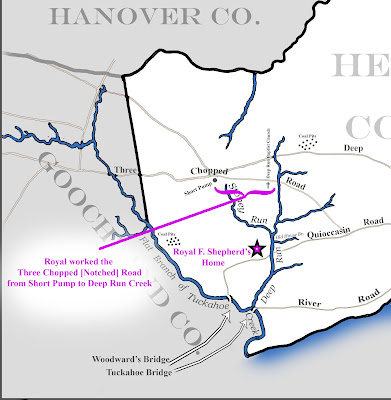
During this era, quality roads were crucial for travel by horse and wagon, as well as, for allowing planters to get their products to market in a timely manner. By law, roads were to be maintained twice a year by court selected landowners bordering the road. They were required to keep the road free of low hanging limbs, remove nuisance rocks, brush and stumps and make repairs as necessary, in an attempt to make travel safer. Most planters utilized their slaves for this labor. On May 6, 1822,
The County Court ordered that the hands of Royal F. Shepherd, Richard Shepherd, Stephen Duval, Zacharia McGruder, Samuel Cottrell, Peter Fletcher, John Blackburn, Samuel Brown, Samuel Cottrell, Jr., and Charles Woodward be assigned to work on the Notched Road from the Short Pump to Deep Run, of which Royal F. Shepherd was appointed surveyor. Royal received $12 for the services he rendered in supervising the roadwork. On October 7, 1822, Royal’s brother David A. Shepherd was appointed surveyor of the road from Hungary Run to the Deep Run Coal Pits, in the place of John Lacy.

In August of 1823, Royal’s aunt Elizabeth Shapard (c.1755-1823) the wife of the late Joseph Duvall (?-1800) died in Henrico County. Her sons, Stephen Duvall (1782-1850), and Obadiah Duvall (1794-?) were the administrators of her estate, with Royal F. Shepherd and John L. Bowles as securities in the amount of $4,000. The County Court commissioned Royal F. Shepherd, John S. Ellis, Jesse Sneed, William Gill and Samuel Brown to settle the account of the administrators of Elizabeth’s estate and report their findings to the court.

Tax records for Henrico County, in 1824, documented that Royal F. Shepherd had three slaves over the age of 16 years, one male and two females. He also had five horses. His brother David A. Shepherd was taxed on two slaves over the age of 16 years and four horses. Their cousin Reuben Shepherd (1803-1892) and Richard C. Shepherd (c.1805-c.1842) were also accounted for on the record as white poles over the age of 16 years. Richard initially appeared in in the tax records in 1823, whereas, Reuben first appeared in 1820. Neither of them had slaves or horses at this time.

On May 5, 1824, Royal F. Shepherd acquired 40 additional acres of land adjoining his property on Deep Run. The land was sold by Charles Nuttall and his wife Maria Longest for the sum of $360. Charles and Maria were married in Henrico County on July 9, 1821. The property was also bounded by the lands of Samuel Cottrell and Samuel Brown.

Royal F. Shepherd and his wife Mildred were blessed with the birth of their third son on September 23, 1824. They named him Royal Fleming Shepherd, Jr. (1824-1863), in honor of his father.

David A. Shepherd and his brother-in-law Fleming Patmon were summoned to be jurors on numerous court cases in 1824. Fleming Patmon (c.1797-c.1849) married Sarah “Sally” Ryall, the daughter of John Ryall (1770-1809) and Mary Smith (?-?), on February 7, 1820. Fleming and David had a tremendous friendship throughout their lives, and were most likely business partners in coal mining or land specualtion. Both men had much in common, Fleming, like David was a slave holder, a staunch democrat and had a reckless entrepreneurial spirit. Fleming and his wife lived along the Richmond Turnpike and Old Coal Pit Road, near David Shepherd’s land. In March of 1822, Fleming was commissioned as Captain in the 33rd Regiment, 4th Division, 2nd Brigade Virginia Militia. In April of 1822, Fleming was appointed as Constable of Upper District of Henrico County, for a term of two years; however, he resigned his position in March of 1823. In the early 1830s, Fleming’s entrepreneurial ventures rendered him financially desperate. He was sued, in 1832, by Sherard H. Johnson, husband of Elizabeth Shoemaker (c.1782-?), for the recovery of a debt, upon which Fleming had bound his farm as collateral. On February 9, 1833, Fleming’s farm of 170 acres upon which he resided, seven miles from Richmond was sold at public auction. Pressed for funds, Fleming also sold off most of his negros, going from three slaves in 1830 to one slave by 1832. Interestingly, as a means of income, in June of 1834, Fleming was appointed as Constable, serving two full terms until 1838. In the 1840s, Fleming resided on 80 acres of land on Old Mountain Road, near his old farm. He died in 1849 in Henrico County.

David A. Shepherd had married Fleming Patmon’s sister Nancy in 1818. In or about the year 1824, Nancy died in Henrico County. She was survived by her husband and daughter Mary Elizabeth Shepherd born circa 1820. Fleming Patmon and his wife Sarah clearly played a significant roll in consoling and caring for David and his young daughter after the tragedy. Through this association, David was introduced to Sarah’s sister Nancy Apperson Ryall (1802-?). Apparently, the match was fruitful, as David A. Shepherd married Nancy A. Ryall circa 1825. David would have two additional children through this union, John David Shepherd (c.1826-c.1895) and Mary Jane Shepherd (c.1828-?).


Nancy Apperson Ryall (1802-?) was the daughter of John Ryall (1770-1809) and Mary Smith (?-?) and was named after her aunt Nancy (Ryall) Apperson. Nancy Apperson Ryall’s (1802-?) father John had died when she was only 6 years old, and it appears that their grandfather James Ryall (?-1812) and his wife Lucy became a source of security for the family. When James died in 1812, he left most of his estate in the form of land and slaves to his grandchildren Nancy and her five siblings, being Mary Jane Ryall who married George King on September 6, 1810; James Smith Ryall (1798-1882) who was a bachelor, John Bacon Ryall (1804-?) who married Maria Cottrell (1808-?) on May 25, 1827, the daughter of Peter Cottrell (1783-1827) (son of Peter Cottrell 1760-1815 and Susanna Shapard 1760-1807) and Sarah Ellis; Sarah Miller Ryall who married Fleming Patmon (c.1797-c.1849) on February 7, 1820; and Betsy Burton Ryall (1800-?) who married John P. White on October 7, 1817.
 
Interestingly, Nancy A. Ryall had a fair amount of wealth for a woman of her age. When her grandfather’s estate was settled in 1818, Nancy was bequeathed a slave girl named Keziah and had inherited 170 acres from the division of land. Upon receiving this property, she appointed John P. White as her guardian, and he gave bond in the sum of $3000. However, by 1819, Martin Smith had become her guardian. It appears that after Nancy and David A. Shepherd married, they resided on the 170 acres of land, making it their home.


On April 6, 1825, the justices of the County Court received a report from Jesse Snead, who was appointed to superintend the election of Overseers of the Poor in the Upper River District of Henrico County. According to the report, David A. Shepherd, Malachi Tinsley, and John S. Bowles were duly elected as Overseers of the Poor in the said district. The three men returned to court the following month where they were interviewed by the justices and qualified to commence their work.

On August 1, 1825, William Gill was appointed as the new surveyor of the road from Deep Run Church to Short Pump in the place of Royal F. Shepherd. Deep Run Church was located on Three Chopped Road, less than two miles from Royal’s plantation. The initial church was founded in 1742 as an Episcopal [Church of England] congregation, and a wooden church was built in 1749. During the American Revolution, favoritism towards Episcopal churches waned and the building was commissioned for use as a war hospital. After the war, a Baptist congregation assembled there, and, in 1791, it became known as Hungry Baptist Church. In 1819, church leaders changed its name to Deep Run Baptist Church, due to its proximity to the Deep Run Creek. It is known that some of Royal’s children joined the Third Baptist Church in Richmond Virginia in the early 1840s. And it is highly probable that the Shepherd family were members of the Deep Run congregation, illuminating their association with the Baptist denomination.

In 1826, Royal F. Shepherd had five slaves, three over 16 years of age and two between the ages of 12 to 16 years. He also had three horses. His brother David A. Shepherd had six slaves, four over the age of 16 years and two between the ages of 12 to 16 years, and four horses. Both men were living in the Upper District of Henrico County as their primary residence. Interestingly, their cousins, Richard C. Shepherd (c.1805-c.1842) and Reuben Shepherd (1803-1892), sons of Reuben Sheppard (1772-1813) and Sarah “Sally” Cocke (?-1822), had sporadically appeared in the Henrico County tax records throughout the 1820s; however, commencing in 1826, and thereafter, they are listed only in Goochland County. For the year 1826, Reuben was listed as having five slaves over the age of 12 years and one horse. His brother Richard had no slaves and one horse.

A celebration was had in 1826, in Henrico County, when Royal’s wife Mildred gave birth to their fourth son. They named the baby William Shepherd (c.1826-?).


Another grand celebration occurred, this time in Goochland County, when, on March 22, 1826, Reuben Shepherd (1803-1892) married Susan G. Jordan (c. 1809-1894). The bride was the seventeen year-old daughter of Reuben Jordan (1773-1826) and Phebe Wingfield (?-1839) who married in Goochland County, Virginia, in 1801. Her father owned a 500-acre plantation in Goochland County, and was the master of approximately 6 slaves. Her parents had eight children whom survived to adulthood: Robert W. Jordan (1802-1856); James B. Jordan; Susan G. Jordan (1809-1894) married Reuben Shepherd; Samuel M. Jordan; Reuben F. Jordan; Joseph W. Jordan; Sarah F. Jordan married Alfred Crump; and Phebe Ann Jordan married J.W. Walton. Tragically, only a few months after Reuben and Susan married, her father died in Goochland County. The young couple inherited a few slaves and a division of her father’s plantation where they initially resided.

During the late 1820s and early 1830s, Reuben began working towards owning and operating his own grist mill and needed the capital to fund such a venture. Over the following years, he would liquidate many of his assets to fund his business endeavor. In 1826, Reuben had five slaves over 12 years of age and one horse, of which, all would be sold over the next four years. Reuben would not invest in another slave until 1834. In 1827, Reuben sold the land that he inherited from his father Reuben Sheppard, Sr. (1772-1813), being 3/4 of an acre land in Henrico County on Deep Run and Old House Branch, for $50 to Stephen Duvall (1782-1850). In 1831, Reuben and Susan sold all their rights to her father’s estate for $450 to her brothers Robert W. Jordan and James B. Jordan.


In 1832, Reuben’s hard work and ambitious savings finally allowed him to realize his dream. On March 31st, he purchased, for $2000, a mill pond with houses and adjoining 10 acres on Tuckahoe Creek in Goochland County from Samuel Leake. He began grinding grist that same year, and his operation became known as Shepherd’s Mill. Over the following years, he purchased additional acres surrounding his mill from John W. Ford, Charles Ford and Benjamin Nuckols. In 1838, his mill was running a healthy profit and Reuben acquired three slaves and had recently purchased an additional 360 acres of land around the mill from John W. Ford for $1000, bounded by Chopped Road and a road leading to Shepherds Mill and Tuckahoe Creek.

However, in 1840, the effects of the economic depression known as the Panic of 1837, had fully reached Goochland County and Reuben found himself in troublesome debt. As early as October of 1837, Reuben and his brother Richard C. Shepherd (c.1805-c.1842), who likely worked together at Shepherd’s Mill, were the defendants in lawsuits filed against them for the recovery of debts. In an attempt to alleviate their financial woe, Reuben and his wife sold the land she inherited from her father on Tuckahoe Creek for $237 to her brother Robert Jordan. Reuben also sold 250 acres for $700, on March 1st to Robert Farrar, adjoining Three Notched Road, being the greater portion of land that he purchased in 1838 from John W. Ford. In June of 1840, Reuben made an agreement to sell at public auction his remining 148 acres on Tuckahoe Creek that included his grist mill if he was unable to satisfy his $669 debt to Charles Ford by December.

From all accounts, Reuben honored his debt to Mr. Ford and retained his mill for the duration of his life. His occupation was listed as a miller in 1870 and a miller and a farmer in 1880. However, he also continued to invest in real estate. At the beginning of the Civil War in 1860, Reuben purchased 65 acres of land known as Little Store for $640, upon which he sold three years later to Jacob Sampson for $1,170. In 1870, he sold 10 acres to Marie L. Watson for $350, being a portion of land from the division of the estate of Reuben’s late brother-in-law Joseph W. Jordan. In 1874, Reuben carved 8 acres from his land along the Three Chopped Road, adjoining the property of Dr. R. G. Parrish, and sold it to Andrew Johnson for $80.

Reuben died at his home on October 16, 1892 at the impressive age of 89 years old. He was a member of the Methodist Church and had favored the Republican Party. His wife Susan G. Shepherd survived him for two more years, passing away on September 9, 1894. Together they had eight children: Sarah A. Shepherd (1827-1900); Elizabeth “Betsy” Shepherd (1832-?); Susan E. Shepherd (1833-?); Lucinda F. Shepherd (1836-1861); Robert B. Shepherd (1840-1908); John W. Shepherd (1843-1923); Phebe J. Shepherd (1846-1913); and Mildred Shepherd (1852-1893).

Circa July of 1826, Royal F. Shepherd’s mother, Mary (Allen) (Sheppard) Cottrell (c.1769-1826) died in Henrico County. She had survived two husbands, Samuel Shapard III [spelled later as Sheppard] (c. 1767-1795) and Charles Waddell Cottrell (1751-1818). After the death of her last husband, Mary remained a widow, residing on her 300 acre estate, for the remainder of her life. Mary’s son Royal F. Shepherd and her step-son Samuel Cottrell became the executors of her estate. An estate sale was held on July 13, 1826 of the remaining personal property, collecting a sum of $1,285.95 to be distributed among the Shepherd and Cottrell heirs.

In the spring and summer of 1826, a new road was to be opened from the Tuckahoe Coal Pits, through the lands of John Wickham, to the James River Canal. The County Court commissioned Royal F. Shepherd, Jesse Sneed, Samuel Brown, John F. Henley and Samuel Cottrell to be appointed commissioners to view the ground along which the new road was proposed and report back their recommendations.

Henrico County was the site of the first commercial coal operation the history of the United States. Coal from the Richmond deposits was first discovered in the county in 1701, and was prized for its high quality. During the 1700s to the early-1800s, this coal was extracted by digging a hole or pit in the ground to a depth of about 30 feet, all the while carving out the coal from the walls, which began about four feet below the surface. The pit eventually filled with rain or ground water, whereby, a new pit was begun, abandoning the former. In the 1760s, Samuel DuVal became one of the first to excavate, transport and sell coal from the Deep Run area. With the labor of ten men, they removed the coal, placed it on wagons or boats and shipped it to Richmond, where it was further distributed for sale. Because of its high quality, Deep Run coal was favored by iron smiths to fuel their furnaces, and even fueled the Westham Foundry for weapon production during the Revolutionary War. In 1786, coal was discovered in the Tuckahoe Valley and landowners along the Tuckahoe Creek capitalized on the opportunity. William Cottrell, Thomas Randolph, John Ellis and John Wickham all had coal fields and shipped the product down the creek, to the James River, and then to market in Richmond.

During the War of 1812, the United States government placed tariffs on British imported coal which caused a shift favoring the number of American consumers purchasing local Virginia coal. As coal production increased, improvements were desperately needed to maintain the roads and waterways for transportation. Safer, wider and more maintained toll roads known as ‘turnpikes’ were constructed as the main coal roads, which could bear the weight of constant wagon flow. During this time the Deep Run Turnpike was constructed from the coal pits directly to Richmond. While these roads initially helped, the high tolls and wagon congestion proved them inadequate long term. Deep Run Creek was also dammed in an effort to maintain its water level to increase the predictability of shipping. In the late 1820s, the Tuckahoe Canal was built to allow easier access to the James River, reaching the Deep Run pits in 1829. During this time, on a larger scale, the James River Canal was being widened, straightened and rerouted to accommodate better water travel for shipping and transportation as part of Virginia infrastructure improvements that would continue through the 1850s.


In the 1810s, large scale coal mining operations began digging deeper and farther underground. In 1818, Henry “Harry” Heth’s mine in the Richmond field reached 300 feet in depth and was the first in the United States to incorporate the use of a steam powered pump to continually remove the ground water. In the mid-1830s, short-span railway systems would be built around the mines at Tuckahoe and Deep Run areas to transport coal with more ease. Although these larger mining operations became increasingly more dangerous due to fires, cave-ins, heavy machinery and poisonous gases, the profitability made mine owning or investing desirous. The profitability of Virginia coal would reach its pinnacle in 1824, holding 60 percent of the coal market. However, as railway systems to larger coal fields in other states, especially Pennsylvania, allowed for higher coal production, easier coal transportation and cheaper coal prices, Virginia coal declined drastically to about 10 percent of the market by 1840. After the Civil War, Virginia coal mining faded into obscurity.

In 1827, Royal Shepherd’s brother David A. Shepherd, of 32 years of age, had created a financially comfortable life for himself. He had 250 acres of land, five slaves and three horses and was in a business partnership with his friend and former brother-in-law, Fleming Patmon. Although it is unclear in what business the two men were involved as partners, it does seem to be linked to the coal industry, possibly as small-scale miners. It is very evident that as the Virginia coal market faltered in the late 1820s, so too did David and Flemings business venture. The first sign of their impending financial woe occurred on November 8, 1827, when Richardson Energy, a small-scale coal company, purchased for a measly $1, the mineral interests that David A. Shepherd and Fleming Patmon had in two tracts of land.

In January of 1828, the same year that Pennsylvania coal overtook Virginia coal in the U.S. market, David A. Shepherd found himself in debt to James P. Taylor in the sum of $217.97, for which he leveraged his negro boy Jesse, three work horses and one wagon and gear as security. Unfortunately, David was unable to pay the debt on time and on June 17th, these items were sold at public auction at Wilson Brackett’s tavern in the city of Richmond. In March of that year, David was $50 in debt to Mosby Woodson and was forced to secured his negro girl Causey to be sold at public auction to satisfy the debt. In April, David was $134.60 in debt to his brother Samuel Shepherd of Richmond, upon which David entered into an agreement that if the debt was not paid, his brother Royal F. Shepherd would sell David’s slave ‘Stephen’ at public auction and disperse the funds accordingly.

The financial ruin and stress felt by David A. Shepherd is evident in that his personal property diminished from five slaves and five horses in 1828, to one slave and two horses only a year later. During this time there were no exemption laws, thus all possessions a person or business owned were subject to be sold to satisfy his debt, generally causing total ruin to the owner. The creditor, if unsatisfied in his personal collection efforts, would force collection of the debt through the courts via lawsuits. However, if still unsuccessful, there was another more dreaded means of at least partial collection. “Shavers,” made a business of purchasing delinquent credit notes at a discount, and then forcing full collection, by the sheriff, who would hold a public auction of some or all of the debtor’s property needed to satisfy his debt.

In an effort to save his home from being taken in bankruptcy or by shavers, David A. Shepherd sold his 170 acres and all his household goods and furniture to his children for $1, on July 28, 1828, “for and in consideration of the natural love and affection which I bear to Mary E. Shepherd, John D. Shepherd and Mary Jane Shepherd…” In August, David sold the land upon which his coal field was likely located for $400 to David Baker. This was the 80 acres of land along the road leading to Burtons’ Coal Field, that he had purchased from Samuel Smith Cottrell in 1817, and was adjacent the lands owned by coalers John Lacy and Heth, Sheppard & Co. (being Harry Heth, Benjamin Sheppard, Robert Gordon and James Carrie). By 1829, David had become completely destitute of property, owning no land, slaves or horses, and he died in 1829 or early 1830, at 35 years of age, in the prime of his life. While David’s business collapse explains his financial demise, his early death creates a mystery. Another possibility was that David may have been badly injured or had an illness rendering him unable to work, thus setting off the chain of events that led to his financial ruin and early demise. Regardless of the cause, this tragic event was devastating to his older brothers Royal F. Shepherd and Samuel Shepherd, whom had all been so close.

After David’s death, his wife Nancy remained on their 170 acre farm in Henrico County, raising her one year old daughter Mary Jane Shepherd (1828-?), her three year old son John David Shepherd (1826-1895), and her nine year old stepdaughter Mary E. Shepherd (1820-?). Fortunately, Nancy’s sister Betsy Burton Ryall (1800-?), whom had married John P. White in 1817, lived next door, and was a great benefit during this time. By 1838, Nancy had gained the assistance and support of her two brothers James Smith Ryall (1798-1882) and John Bacon Ryall (1804-?) whom had acquired John P. White’s land next to the Shepherd’s farm. In 1851, Nancy A. (Ryall) Shepherd finally sold the 170 acres of land in Henrico County, that she inherited from her grandfather’s estate in 1818, to her son John D. Shepherd for five dollars. Nancy died in Henrico County on July 10, 1859, of consumption.

At present, little information has been recovered pertaining to David and Nancy’s daughters; However, there is an abundance of records pertaining to their son John David Shepherd (1826-1895). In 1848, John married Cordelia E. Ford (1825-1876). They would raise eight children on the 170 acre farm upon which John was born. After the death of his first wife, John married Odora Mildred Cauthorne of Hanover County, Virginia. Together they would rear an additional five children in Henrico County. John D. Shepherd died circa 1895.

Circa May of 1827, Royal F. Shepherd’s cousin Peter Cottrell (1783-1827) died in Henrico County. Peter was the son of Peter Cottrell (1760-1815) and Susanna Shapard (1760-1807). Peter married Sarah “Sally” Ellis on November 26, 1804, in the city of Richmond, Virginia. They had seven children: Lucy, John, Maria, Sarah, Peter, Reuben and Caroline. During the War of 1812, Peter served as Sergeant in the 33rd Regiment Virginia Militia commanded by Capt. William Henley. On May 12, 1827, the Henrico County Court appointed Royal F. Shepherd, Stephen Duvall, John Bowles, Malachai Tinsley to appraise the estate of the late Peter Cottrell. His wife, Sally Cottrell, was given guardianship of the minor children.

In late 1828 or early 1829, Royal F. Shepherd’s wife gave birth to a daughter. They named her Jane Ann Shepherd (c.1829- 1895). This would be the last child born within their union.

In 1829, Royal F. Shepherd was residing in the Upper District of Henrico County, specifically in Precinct 13. Henrico County authorities had divided the county into precincts in 1823, for greater ease of land processioning and voting. Royal’s brother David A. Shepherd resided in Precinct 17. In 1829, the Henrico County personal property tax list documents that Royal F. Shepherd had five slaves. Four of the slaves were over the age of 16 years old, and one of the slaves was between the age of 12 to 16. He also had four horses.